01 — Overview
Bringing AI-native research to crypto's most demanding users
Messari provides crypto intelligence to institutional investors and protocol teams. When OpenAI, Google, and Perplexity launched deep research products in early 2025, we saw an opportunity: our proprietary data layer could power something these general-purpose tools couldn't. I was the sole designer on the initiative to bring Deep Research to Messari's Copilot platform.
02 — Vision
Messari platform should offer an intelligent tool that can create on-demand long form personalized research for users by tapping into our vast datasets and AI capabilities.
Messari's enterprise customers were spending significant time producing reports that combined market data, protocol analysis, governance updates, and competitive intelligence. Meanwhile, general-purpose AI tools were starting to handle surface-level queries, but they couldn't access Messari's proprietary data layer — our unique advantage.
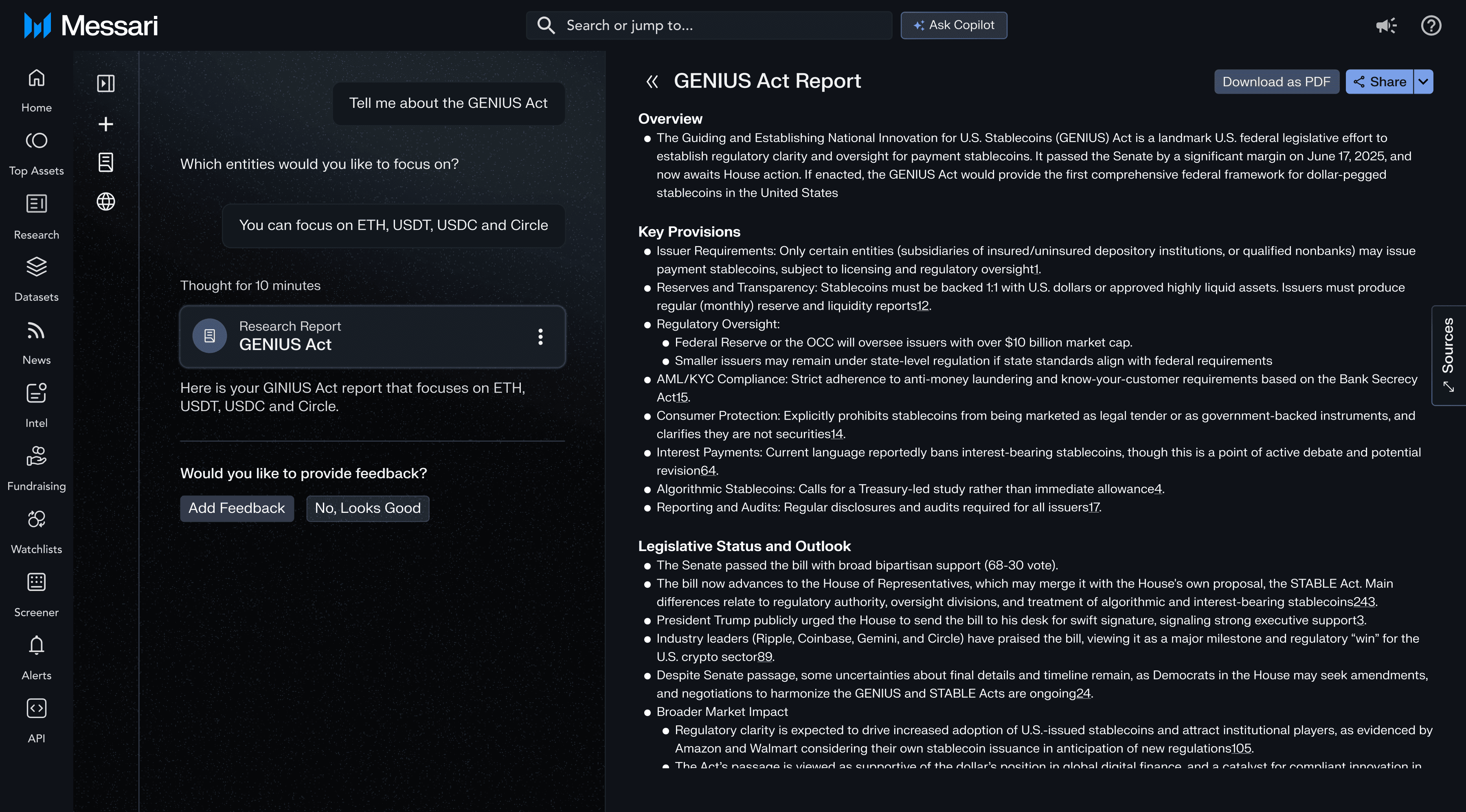
Key challenges I identified
Through stakeholder interviews, competitive analysis, and reviewing user feedback from our existing Copilot chat product, three core tensions emerged. First, users expected depth and accuracy from an institutional platform — hallucinated data or shallow analysis would erode trust. Second, the existing Copilot was chat-based and ephemeral, but research reports needed persistence, structure, and shareability. Third, we had to differentiate from the flood of general-purpose deep research tools by leveraging Messari's proprietary data, charts, and intelligence.
03 — Design Process
From prompt to published report
The core design challenge was creating a flow that felt seamless across three distinct phases: report initiation, generation with real-time feedback, and post-generation refinement. Each phase had its own interaction model and constraints.
Report creation
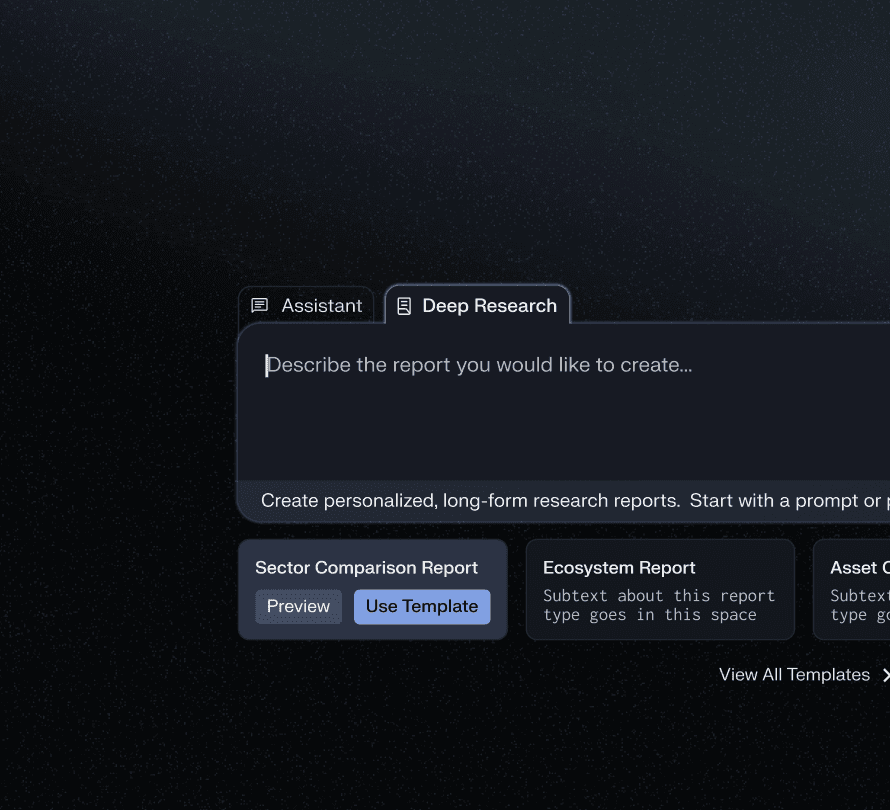
I designed the creation flow as a dual-mode interface within Copilot: users toggle between "Assistant" (standard chat) and "Deep Research" (long-form generation). The Deep Research tab surfaces report templates and accepts freeform prompts, lowering the barrier for both new and experienced users.
Generation & real-time feedback
This was the most complex interaction to design. Deep Research reports can take some time to generate — longer than a chat response. I designed a split-panel layout where the left rail shows the conversational context (the AI's research card, timing, and feedback area) while the right panel progressively renders the report with real data visualizations, asset charts, and cited sources.
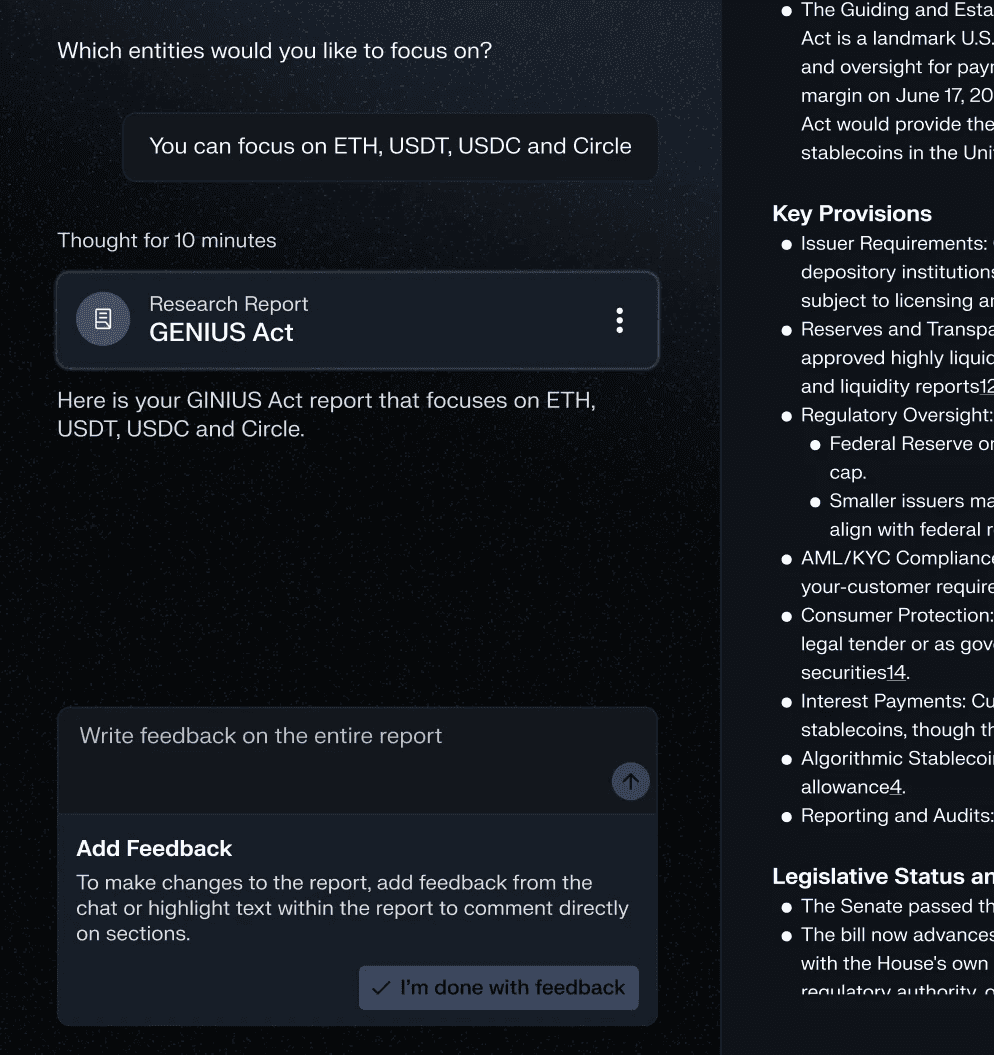
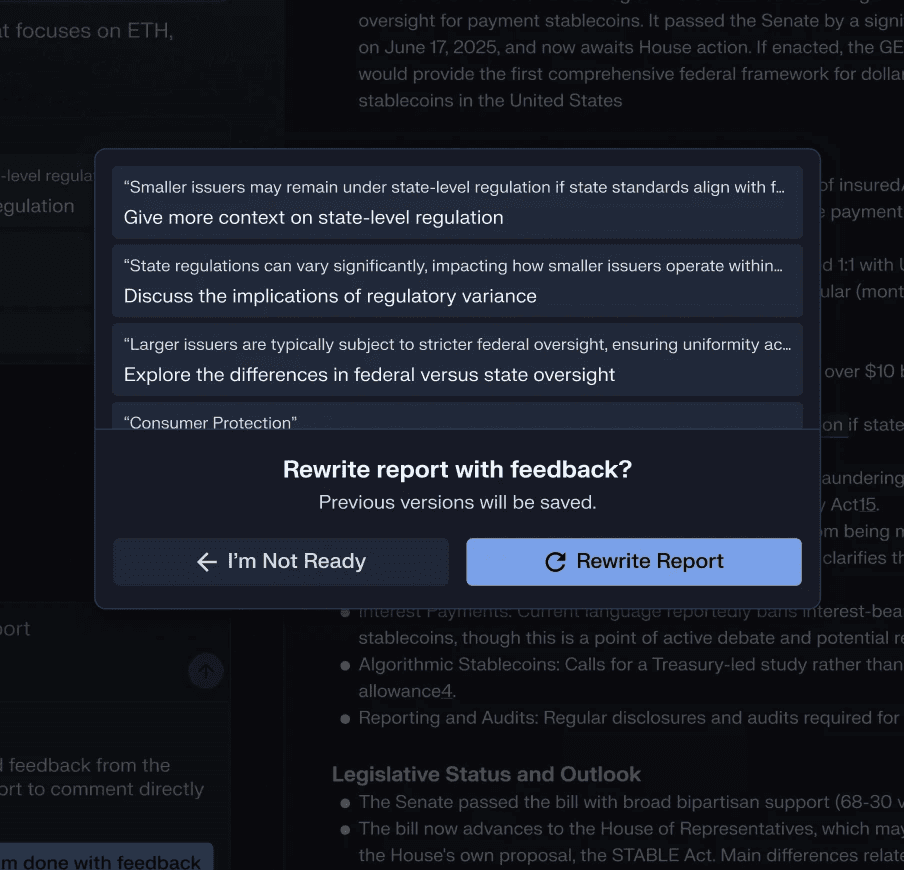
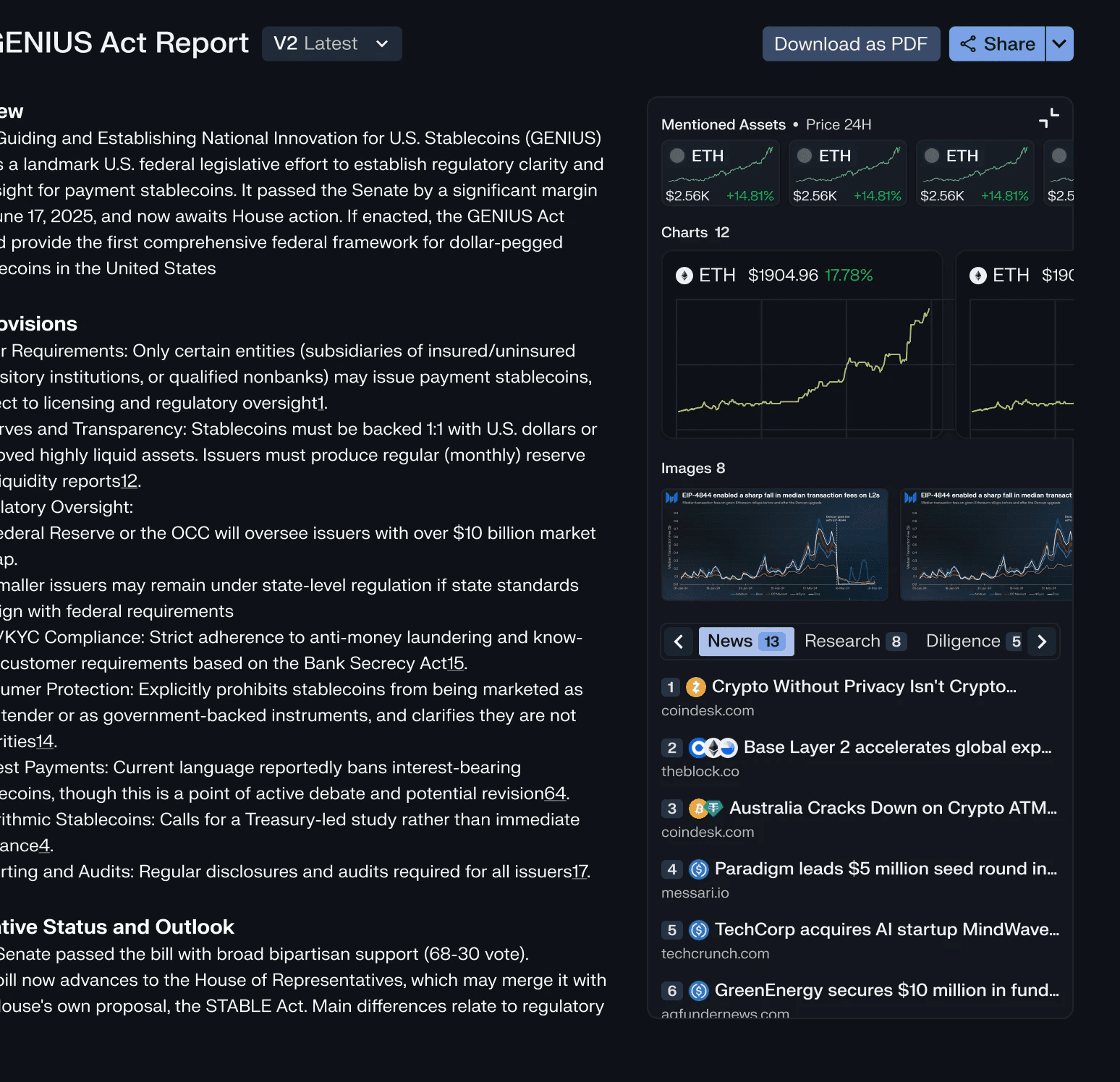
"The sidebar is what makes this feel like Messari instead of just another AI wrapper. Seeing the actual chart data and news citations alongside the report — that's the trust signal our users need."
— Internal research team feedback
04 — Template System
Encoding research expertise into reusable frameworks
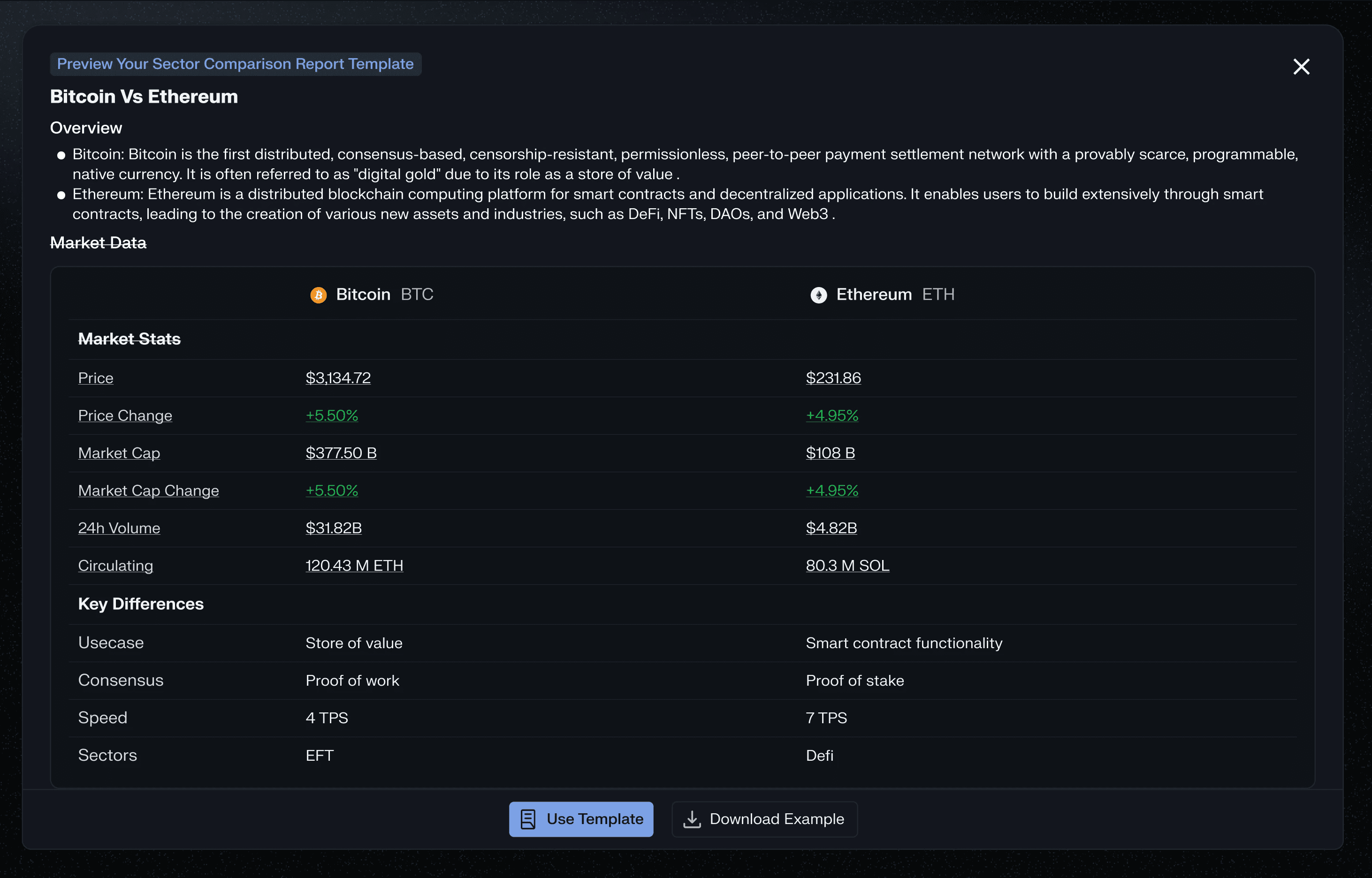
One of the most strategically important design decisions was the template system. Rather than requiring users to craft the perfect prompt from scratch, I designed structured templates that encode Messari's institutional research frameworks — Sector Comparison Reports, Ecosystem Reports, Asset Comparison Reports, Asset Due Diligence, and Periodic Project Recaps.
Each template includes section headings, subheadings, and detailed guidelines that instruct the AI on what to analyze and how to structure the output. This was directly informed by stakeholder feedback from our research team, who wanted users on the Enterprise tier to be able to create, save, and share their own custom templates.
Monetization through design
The template system also served as a natural monetization lever. Free users see a preview of templates with an upgrade prompt, while Enterprise users get unlimited generation and custom template creation. I worked closely with product management to design the credit system UX — showing remaining report credits inline at the creation step so users always know where they stand before committing to a generation.
05 — Information Architecture
Structuring Copilot for two modes of thinking
A key UX challenge was integrating Deep Research into the existing Copilot product without disrupting the chat-first mental model. I restructured the sidebar to clearly separate two content types: Deep Research reports (persistent, structured, shareable) and Chat conversations (ephemeral, exploratory, quick). This distinction helped users build the right mental model for when to use each mode.
User flow architecture
Entry
User enters a research query or selects a pre-built template
Generation
~10 min generation with Messari data, news, and on-chain sources
Review
User provides inline feedback to refine sections
Output
Download as PDF, share link, or continue iterating
06 — Outcomes & Impact
Measurable impact across the business
Deep Research launched as a core feature of Messari's Copilot platform, available to Enterprise and Pro subscribers. The feature became a key differentiator in sales conversations and directly contributed to platform retention.